The venous blood test is the gold standard for biomarker detection in blood but it's painful, invasive, and does not enable continuous monitoring of blood contents. Blood is taken out for analysis, and the results leave patients with mere snapshots of their health condition instead of the ability to continuously monitor one’s biomarkers, which are pieces of information that can shed light on aspects of our health.
Qing Cao is working in Kaiyu Fu’s laboratory within the Department of Chemistry and Biochemistry to develop an alternative to the typical venous blood test. The lab’s solution enables continuous, painless, and real-time detection of multiple biomarkers for advanced healthcare applications. This alternative consists of developing a bio-nano interface design for multiplexed wearable biosensors—miniature devices that monitor several biomarkers—on microneedles.
In the production of the microneedles, the Fu lab uses laser cutting to build up a mold using a flexible polymer. Laser power controls the geometry of this pattern, which can be about 200 to 1500 microns in length. For reference, a human hair is about 70 microns wide.
Because the microneedles are so short, they do not reach the pain receptors in the skin, making them painless. Though they cannot reach the blood, Cao noted that this is no problem.
“The needle is only micros, so it cannot detect something directly from the blood, but it can reach the interstitial fluid. In the interstitial fluid, there's a high similarity to the biomarker levels in our blood, so it's a very good alternative,” said Cao.
Cao’s microneedles enable the simultaneous detection of multiple biomarkers through electrochemical analysis. She is working on proposing a needle design in which its platform includes multiple microneedles, each equipped with the ability to detect distinct biomarkers or individual drug release. In this design, the needles can be used for multiple functions simultaneously because each microneedle can work independently.
“During the fabrication, we can load drugs inside the needle surrounded by soluble materials so that when it's parked under the skin and in contact with interstitial fluid, the material will dissolve and the loaded drugs can be released in the skin,” Cao said.
She uses different combinations of materials to make distinct solubilities required to release certain drugs. Some can release very fast, while others release very slowly, giving it a time-controlled mechanism.
Cao’s next step is to use the microneedles as multi-functional tools. She proposes that researchers can insert a needle in the top of an organoid, an artificially grown mass of cells or tissue that resembles an organ, to function in a drug release process, while a bottom electrochemical needle simultaneously functions in the detection of the drug function.
“Microneedles will allow translation of data directly to a doctor combined with intelligent AI tools,” Cao said. “A doctor can give feedback to the patient, preventing the patient from needing to go to the hospital too frequently. The doctor can also do remote diagnoses of simple diseases.”
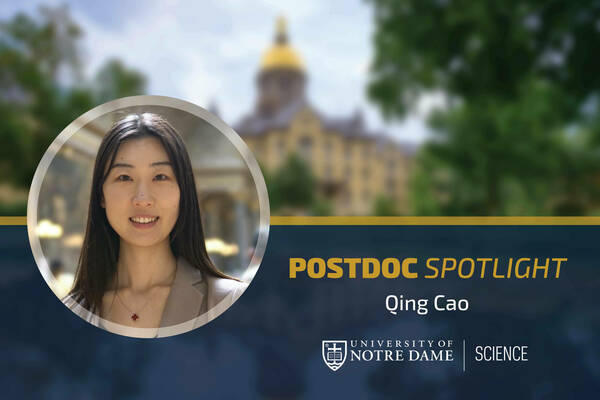
Cao received her doctoral degree from Free University of Berlin, Germany last year and joined Notre Dame in February of 2025, where she received a Provost's Postdoctoral Society of Science Fellowship.
During her doctorate, Cao carried out fundamental research on two-dimensional materials such as graphene and molybdenum disulfide, focusing on their photoelectronic properties.
Cao said that Fu's expertise in biosensor research offers “a highly promising application for the materials she had previously studied.” She looks forward to bringing her background into the fast‑growing field of biosensing and exploring innovative ways to use two-dimensional materials in this space.
Originally published by at science.nd.edu on January 16, 2026.