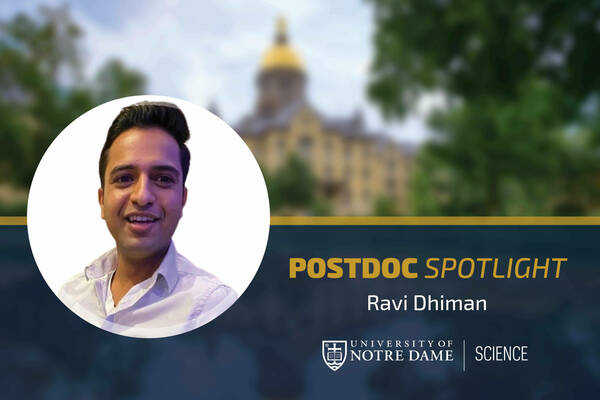
“If you solve even a small part of the puzzle in your cancer research, you can make an impact in the lives of patients.”
Ravi Dhiman, a current Society of Science Postdoctoral Fellow, is a new addition to the world of cancer research, working in the lab of John M. and Mary Jo Boler Associate Professor Xin Lu in the Department of Biological Sciences. He completed his undergraduate degree in India with honors in biotechnology engineering.
For Ravi, science has always been about asking fundamental questions. While many in his family followed careers in computer engineering. Dhiman took a different path—one that led him to biology and cancer research at the University of Notre Dame.
“As a trained biochemist, we can break things down and understand what’s happening at the molecular level. That was more intriguing to me than working with computers,” said Dhiman, whose family members are engineers.
Dhiman earned his master’s degree in biotechnology at Justus Liebig University of Giessen in Germany, where he studied how mitoribosomes—the critical protein synthesizing machineries inside mitochondria- are assembled in mammalian cells. He then completed his doctorate degree in medical biochemistry & molecular biology at Saarland University, also in Germany. His doctoral research was focused on understanding how proteins organize within lipid droplets, specialized cellular organelles that store fat and play key roles in metabolism and disease.
Dhiman then made a career shift to cancer research when he came to Notre Dame. He said he wanted to apply his background in biotechnology and biochemistry to a more translational field.
“You get insight at the basic level, but your work also matters to people,” he said.
In Lu’s Lab, Dhiman investigates how stress signals originating in cancer cells transfer to surrounding cells within the tumor microenvironment. His work seeks to uncover how these stress signals manipulate immune cells, enabling tumors to grow, evade the immune system, and spread throughout the body. His research is focused specifically on prostate cancer, where he studies patient-derived cell lines to identify novel molecular targets that could one day lay the groundwork for new therapies.
Dhiman enjoys the open-ended nature of academic research.
“In industry, the main focus is often to develop a specific drug,” he said. “But here, we can look at molecular pathways to try and solve the puzzle. I’m really trying to understand what drives cancer at the molecular level and see how we can intervene.
Dhiman was excited to be given the opportunity to be a part of the Society of Science fellowship. He wanted to pursue independent research and design a project combining his experience in biochemistry with cancer research, and the fellowship allowed him the flexibility to do so with support from the program director, Adam Martin.
Looking ahead, Dhiman hopes to pursue a career that includes mentoring and academic leadership. He is currently a part of a Notre Dame teaching workshop, which is a five-day program split over five months for fellows interested in developing their instructional skills.
“One of the greatest perks of the Society of Science Fellowship is how it supports both research and professional growth,” Dhiman said. Through the fellowship, Dhiman also took part in a three-minute lightning research talk competition, where he earned third place in the College of Science at Notre Dame—an experience he says strengthened his communication skills and confidence as a scientist.
Dhiman’s transition to South Bend from abroad wasn’t too difficult, as he has family nearby in Kokomo, Indiana. He plans on attending a game during his time at Notre Dame.
“I’m not into football, so I’m thinking I should learn more about this big tradition here!”
He also enjoys traveling, having visited multiple countries across Europe and now seeing what the Midwest has to offer.
Originally published by at science.nd.edu on December 16, 2025.